River Mountains Loop Trail

Facebook icon

  • Home
  • About
  • Trailheads and Maps
    • Trailheads in Boulder City
    • Trailheads in Henderson
    • Trailheads in Lake Mead NRA
  • History
    • Geology of the River Mountains
    • A -Desert Tortoise – Do’s & Dont’s
    • Keep It Clean
  • Blog
    • Recently on Facebook
  • Contact
    • Contact List
  • Donate

Archives for December 2009

Volcanoes in the River Mountains

Volcanoes in the River Mountains ? – This phrase will certainly get the attention of locals who live in the area, particularly if you are not into the geology of the area.  This information certainly explains why the River Mountains are so rugged.  Since it has been 40 years since I took geology I’m going to reference material from Nevada Bureau of Mines and Geology Special Publication #16 ” Geologic tours in the Las Vegas area”.  


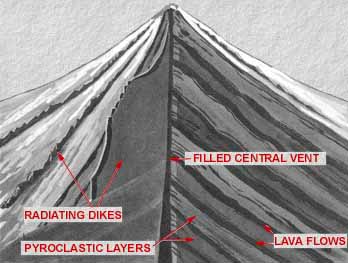
The River Mountains are composed of tilted and faulted mid-Miocene (15 to 12 million years old) andesite and dacite lava flows.  Two volcanoes, the source of most of the lava, have been identified in the River Mountains.  The first, located just north of Boulder city, is a stratovolcano surrounded by numerous domes.  Stratovolcanoes are cone-shaped features composed of lava flows interbedded with abundant agglomerate and breccia that formed from explosive eruptions.  The surrounding domes formed by the eruption of very sticky lava such as dacite, which erupted to the surface but did not flow.   Lava formed a low spine or a dome that quickly crumbled to a ring of debris about the dome.  

Stratovolcanoecross section - USGS file photo

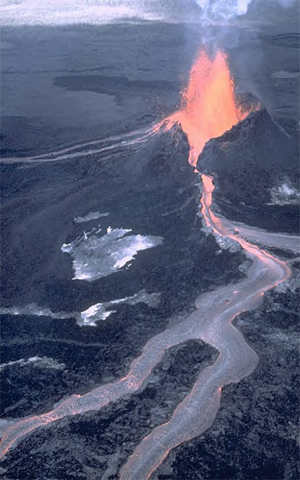
The second volcano, located in the northern part of the River Mountains, is a shield volcano – a broad volcano composed of basaltic and andesitic lavas similar to those erupting today on the island of Hawaii.  

Both volcanos have been tilted, cut by numerous faults, and broken into numerous parts producing a jigsaw pattern of rocks that is now very difficult to recognize.  

This could have been River Mountains 14-million years ago. birth of a Mtn. range.

The following photo is of a cinder cone just a mile north and east of the River Mountains and can be seen from the trail between MM 12 and MM 14.  Locally it is called “Lava Butte”.
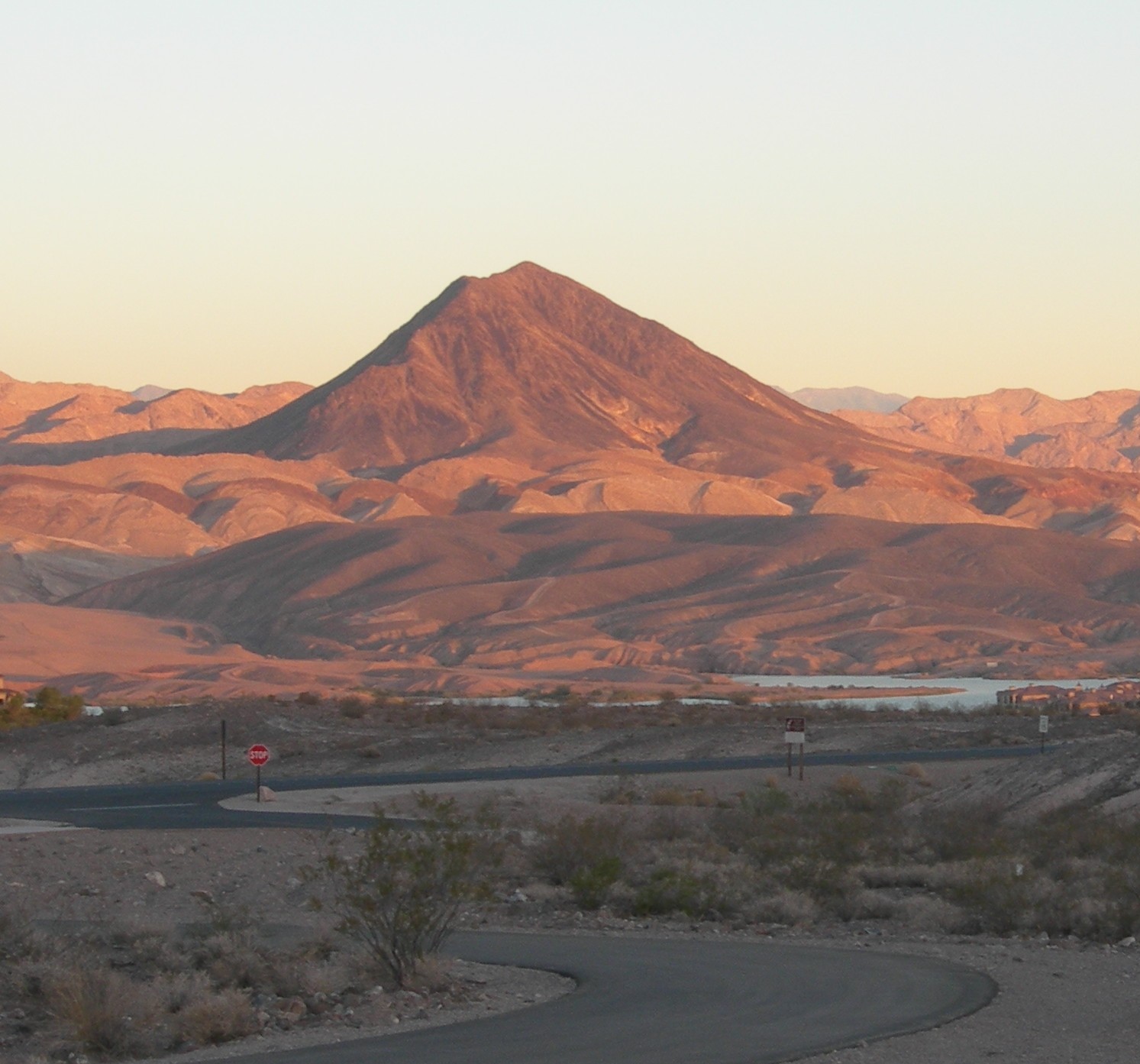
Volcano cine cone North of trail 102409
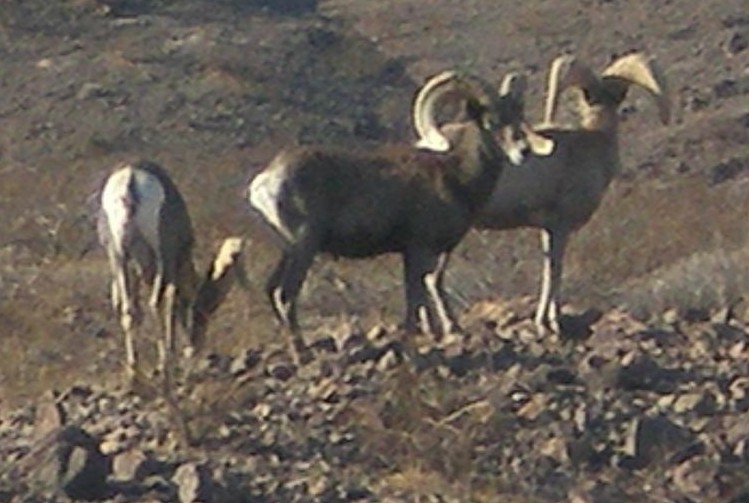
Desert Bighorn Sheep of the River Mountains

Desert Bighorn Sheep (Ovis Canadensis) – Range throughout the River Mountains an are often seen on or next to the trail.  Rams grow to 5 to 6 feet long, ewes grow 4 to 5 feet; study, muscular build; brown to tan with white belly, rump, muzzle and eye patches.

Three Bighorn Ram sheep near the trail – photo by Paul G. 112408

Rams have massive horns that grow over and behind the ears in a C-shaped curl.  Horns are permanent and grow incrementally year by year.  It may take 7 to 8 years for a ram to acquire a full curl. Ewes have a shorter, more slender horns that curve gently back.

The River Mountains are perfect habitat;  for the bighorn sheep occupy rough, precipitous terrain near sources of permanent water.  Bands follow regular feeding routes and maintain bedding grounds that may be used for years.  The desert bighorn sheep is Nevada’s state mammal.

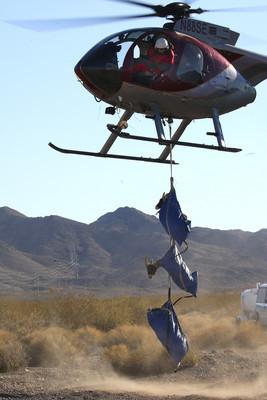
The sheep population in the River Mountains is estimated at 200+.  In order to protect this herd of sheep the BLM has designated a good portion of the Northwest mountain range as an “Area of critical Environmental Concern” (ACEC) to help protect this productive herd of bighorn sheep.  Each year to keep this herd in balance the National Wildlife Service culls the herd by capturing sheep and re-locating into other mountain ranges in Nevada and elsewhere in the west.

RJ photo – Bighorn sheep capture fall 2007 in the River Mountains

The symbol or image used to identify the River Mountains Loop Trail is an image of a Bighorn Sheep on a mountain with the sun rising behind or the moon.  The sheep image is copied from the local rock art symbol for bighorn sheep used by Native Americans. This logo is used on maps, trail kiosks, trail monuments etc.

River Mountains Loop Trail logo – Bighorn sheep on Mountain with Sun rising behind

Photo Gallery Big Horn Sheep:

Desert Tortoise

Desert tortoise (Gopherus agassizi) – Nevada’s official state reptile, is the only naturally occurring tortoise in the Mojave Desert and is on the U.S. fish and Wildlife Service’s Endangered Species List. Over 6 million acres within the Mojave Desert, including over 1 million acres in southern Nevada, have been designated as critical habitat for the desert tortoise(areas that require special consideration and protection). This special consideration includes construction of tortoise fences in areas where highways or construction sites conflict with the tortoise life-style.
Desert tortoise are quiet and unassuming creatures, they spend most of their lives underground in winter dens and summer burrows where they are protected from the temperature extremes of the Mojave Desert. They are long-lived vegetarians, and are so efficient in their water usage that they can survive for more than a year without access to “free” water ( water derived from sources other than the plants that they eat). 

Desert Tortoise on trail by john

The desert tortoise population has been decreasing in recent years throughout the western Mojave Desert.  One of the major factors in this decline is thought to be destruction of tortoise habitat by urban development.  This is especially critical in areas surrounding Las Vegas where the city is rapidly expanding into prime tortoise habitat. 

If you are lucky enough to see one of these elusive desert dwellers, DON’T TOUCH OR PICK IT UP.   They tend to lose water if picked up, to the tortoise it could be fatal to lose this stockpiled water. 

****** 

Note:  The River Mountains is home to a large population of Desert Tortoise. The River Mountains Loop Trail passes through prime tortoise habitat and they are often seen near or on the trail.

White-tailed Antelope Ground Squirrel

White-tailed antelope ground squirrel

The White-tailed Antelope Ground Squirrel (Ammospermophilus leucurus) is gray with a narrow white stripe along each side.  The underside of its tail is white and is carried over its back.  One of the few small mammals to be active in the heat of the day, this animal is superbly adapted for desert life: 

  • It is omnivorous(feeding on both plants & animals) and prefers water-filled plants and insects.
  • It tolerates a nine-degree fluction (100-109 degrees F) in body temperature as it moves in and out of the sun.
  • It can salivate heavily and spread mositure over its neck and cheeks for evaporative cooling effect.
  • It can lose heat by conduction when it retires to the shade or is burrow and flattens itself against the ground.
  • It will postion itself parallel to the Sun’s rays and shade its body with its tail.

Editors note:  These guys in urban areas can become real pests digging up golf course greens and of course your lawn at home.

Recent Blog Posts

Dogs on the Trail

Las Vegas Hiking Trail Featured in Article

Las Vegas Hiking Trail Featured in Article

Pacifica trail head Boulder City on the new trail website.

New Trail Website

Be Sure to Visit

Latest Posts on Facebook

Comments Box SVG iconsUsed for the like, share, comment, and reaction icons
Author Avatar
River Mountains Loop Trail
1 month ago
Come and join us on

Come and join us on March 14th! ... See MoreSee Less

View on Facebook
· Share
Share on Facebook Share on Twitter Share on Linked In Share by Email
View Comments likes 3 Shares: 0 Comments: 0

0 CommentsComment on Facebook

Author Avatar
River Mountains Loop Trail
1 month ago
Love our trail!

Love our trail!🎙️ New Podcast Episode Alert 🚨

Ever wondered what it takes to maintain 34 miles of paved paradise? 🌵

In this episode of The Best Dam Podcast, Howard is joined by Paul Grube, President of the River Mountains Loop Trail Partnership. Paul takes us behind the scenes of one of Southern Nevada’s most beloved outdoor assets—the River Mountains Loop Trail.

www.bouldercitychamber.com/connecting-communities-34-miles-of-cycling-hiking-and-history-on-the-r...

From its "happy hour" beginnings in the late '90s to becoming a world-class 34-mile loop connecting Boulder City, Henderson, and Lake Mead, this trail is a testament to community vision.

Highlights include:

🐢 The funny story of the "moving rock" (spoiler: it was a tortoise!).
🐑 Tips for spotting bighorn sheep and other local wildlife.
🛠️ How the Partnership acts as the "eyes and ears" to keep the trail safe.
🚲 Why you don’t even need your own bike to get started.

Whether you’re a hardcore cyclist or just love a morning stroll, you won’t want to miss Paul’s insights on this local treasure! ☀️
... See MoreSee Less

View on Facebook
· Share
Share on Facebook Share on Twitter Share on Linked In Share by Email
View Comments likes love 6 Shares: 1 Comments: 3

3 CommentsComment on Facebook

Author Avatar
River Mountains Loop Trail
2 months ago

FYI... For those who ride and hike Historic railroad trail....

... See MoreSee Less

Link thumbnail

Grant for erosion repairs will improve Historic Railroad Trail at Lake Mead

www.msn.com

A $250,000 grant from the James M. Cox Foundation, the charitable arm of Cox Enterprises, will support erosion repairs for the Historic Railroad Trail near Lake Mead.
View on Facebook
· Share
Share on Facebook Share on Twitter Share on Linked In Share by Email
View Comments likes 11 Shares: 0 Comments: 0

0 CommentsComment on Facebook

Load more

View Full-Sized